> For the complete documentation index, see [llms.txt](https://docs.spacetoken.tech/llms.txt). Markdown versions of documentation pages are available by appending `.md` to page URLs; this page is available as [Markdown](https://docs.spacetoken.tech/dev-ressources/infrastructure/xerc20.md).
# xERC20
***
### xSPACE and xERC20
**xSPACE** is the official cross-chain representation of **SPACE**, built on the **xERC20 (ERC-7281)** standard. It was introduced to avoid the typical “wrapped token” failure modes (fragmented liquidity, bridge-controlled token contracts, and operational lock-in), especially after incidents like the Multichain collapse that left many bridged assets stuck or illiquid.
In practical terms: **SPACE remains the canonical token on its native chain**, and **xSPACE is the standardized, issuer-controlled token that can exist on multiple chains without relying on a single bridge’s wrapped asset contract**.
***
### Why xERC20 exists
Traditional bridging often works like this:
* A bridge deploys *its own* token contract on the destination chain (a “wrapped” version).
* Liquidity and usability depend on the bridge’s design and its token’s acceptance.
* If that bridge halts, is exploited, or loses keys, the wrapped supply can become stuck, unredeemable, or heavily discounted.
xERC20 changes the model by keeping **token contract control with the issuer** and granting bridges **explicit mint/burn permissions with limits**, so you can diversify bridge risk and revoke access if needed.
***
### Core mechanics
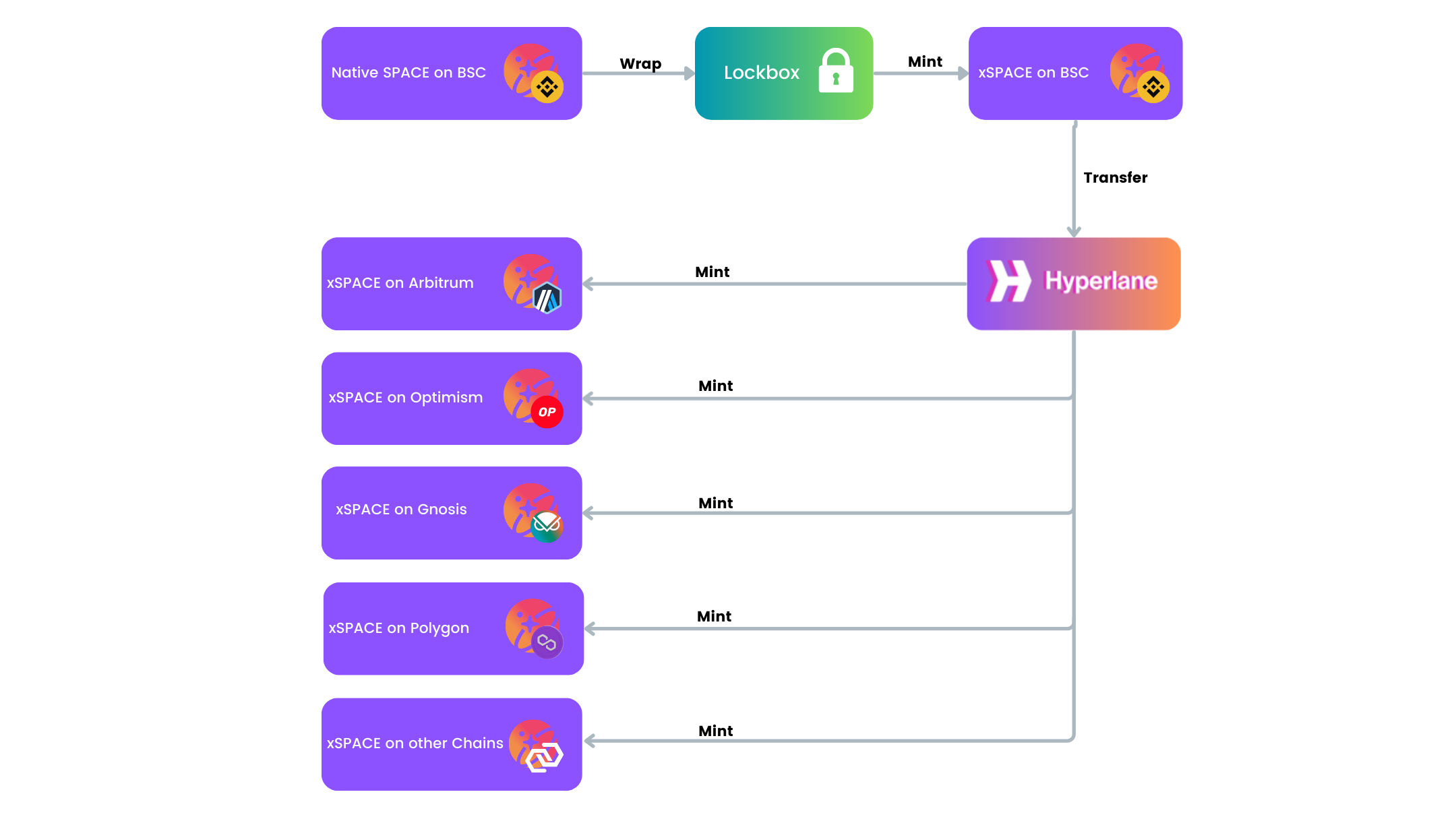
Native SPACE is bridged across chains via Hyperlane go through this flow
#### 1) Lockbox on the canonical chain
On the canonical SPACE chain, a **Lockbox** contract escrows the underlying token and serves as the anchor for supply integrity. The typical flow is:
* **Lock** SPACE in the lockbox on the origin chain.
* **Mint** xSPACE on the destination chain (by an authorized bridge/module).
* When returning, **burn** xSPACE and **unlock** SPACE from the lockbox.
#### 2) Bridge permissions and rate limits
xERC20 lets the issuer authorize one or more bridge modules to mint/burn xSPACE, while enforcing:
* **Who** can mint/burn (per bridge/module)
* **How much** can be minted/burned over time (rate limits / caps)
* **Revocation** if a route becomes unsafe or obsolete
This is the main security/operational advantage: **you’re not married to one bridge forever**.
#### 3) Fungibility and “official token” UX
Because users receive the same **official xSPACE contract** on the destination chain (not a bridge-specific wrapped asset), the experience is simpler:
* less confusion between multiple “SPACE” variants
* less liquidity fragmentation across wrappers
* and, in many setups, no need to bootstrap deep liquidity purely for bridging UX
***
### Our current bridge stack: Hyperlane
We now use **Hyperlane** as the primary bridge layer for xSPACE. Hyperlane’s **Warp Routes** include an **xERC20 integration** (HypXERC20 / HypXERC20Lockbox) designed specifically to move xERC20 tokens across chains while preserving issuer control and supporting lockbox conversions.
A good way to describe this in your docs:
* **Hyperlane Warp Routes** are the token-bridging application layer.
* **xERC20** is the token standard that enforces issuer sovereignty, permissions, and limits.
* Combined, they provide a modular path to expand to more chains without recreating a new wrapped-asset design each time.
***
### What users should expect
When bridging SPACE ↔ xSPACE:
* **1:1 peg logic** is enforced by lock/unlock + mint/burn accounting.
* The destination asset is **xSPACE (official contract)** rather than a bridge-specific wrapped token.
* Bridge risk is managed through **issuer-controlled permissions and limits**, with the ability to rotate/replace routes over time.
***
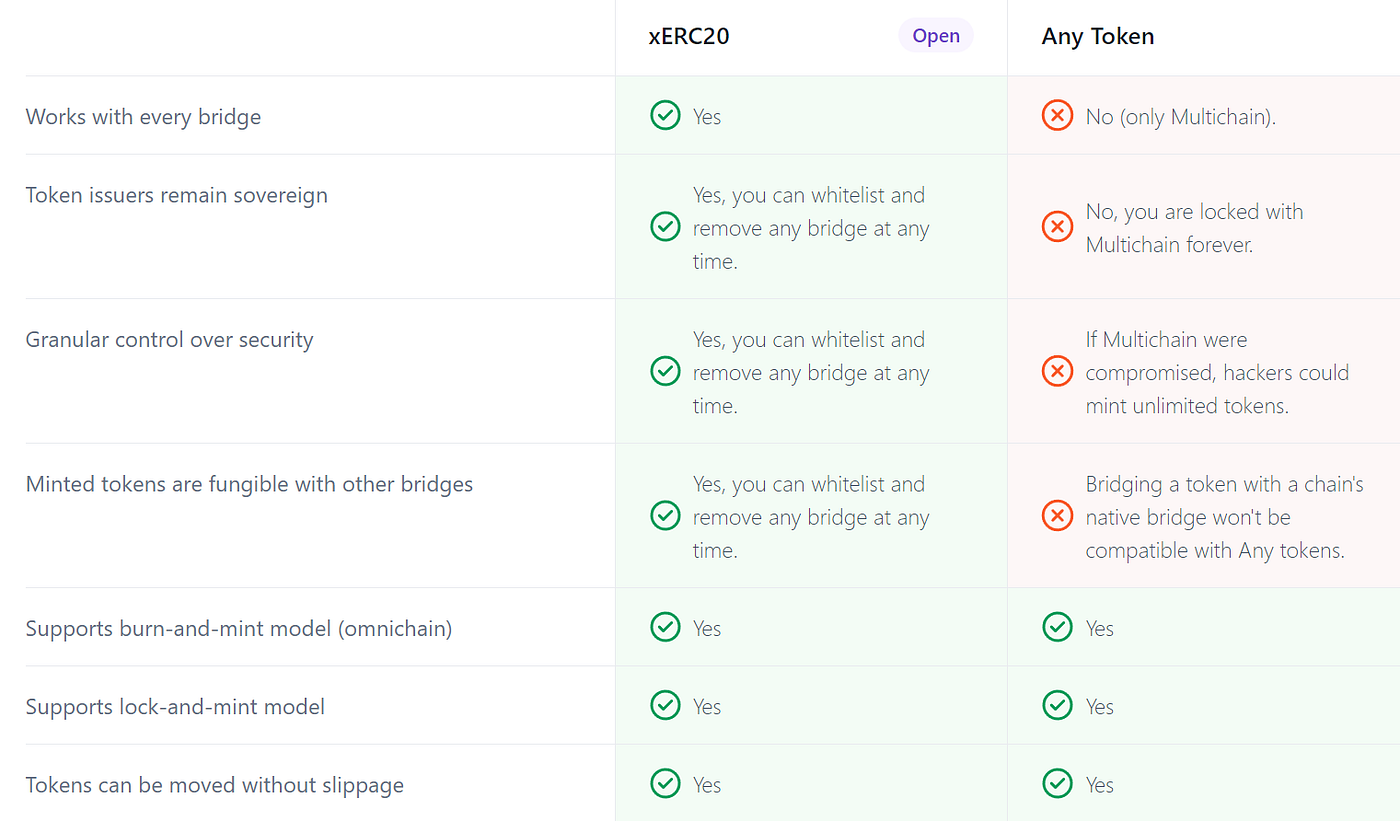
### How xERC20 Enhances Cross-Chain Interactions
Comparative Table between ***xERC20*** and ***any Token*** Standards
### Glossary
* **SPACE (canonical):** the native token on the canonical chain.
* **xSPACE:** the official xERC20 representation of SPACE deployed on supported chains.
* **xERC20 (ERC-7281):** cross-chain token standard with issuer-controlled bridge permissions and limits.
* **Lockbox:** escrow contract anchoring 1:1 backing on the canonical chain.
* **Warp Route (Hyperlane):** Hyperlane’s token-bridging framework; includes xERC20 modules.
***